Building a B2B channel for a retail manufacturer
Lalunz manufactures children's clothing and sells it to Armenian customers. Corporate orders represented an unaddressed segment. Stamina developed the go-to-market strategy, implemented the CRM behind both channels and ran the outbound campaign.

Two channels, two pipelines, one system
Lalunz had an established retail operation. What it lacked was a defined route to corporate buyers and a consolidated record of commercial activity.
- Retail customers and corporate accounts run in separate pipelines with their own stages.
- Corporate deal status can be reviewed without consulting the account owner.
- Each location's performance is visible alongside the corporate channel.
- The corporate win rate is measured, which makes the channel forecastable.
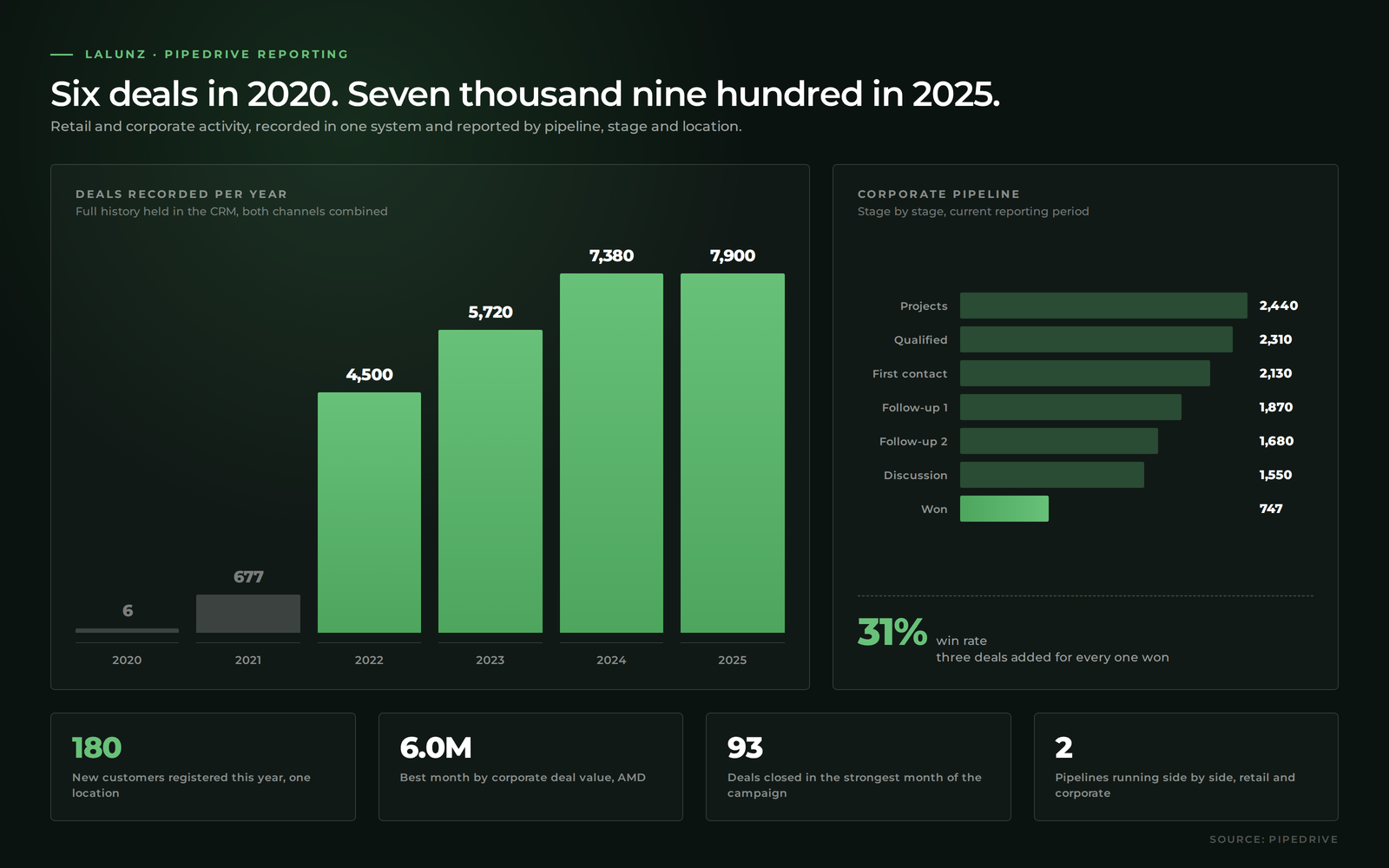
- Six years of commercial activity are held in one system and reportable by year.


About Lalunz
Lalunz is an Armenian manufacturer of children's clothing and accessories for ages nought to twelve, founded in 2018 and on the market since June 2019, operating from five locations in Armenia.
The brand designs its own fairytale characters and builds collections around them, alongside ranges drawn from Armenian culture: the Yerevan collection, the Saryan collection, Hayazard. The company manufactures what it sells, giving it direct control over product development and production capacity.
Corporate procurement differs substantially from retail trade. A corporate buyer orders in volume, decides through more than one person, and takes weeks to do it. A manufacturer can serve that demand profitably, but only with a process designed for it.
No route into the corporate market
The retail operation performed well. The corporate segment remained unaddressed, for three reasons.

No go-to-market strategy
There was no definition of which organisations to approach, what to offer them or at what price. Corporate orders were received opportunistically rather than pursued, leaving the segment dependent on inbound interest.

Customer relationships held in Excel
Contacts and orders were held in spreadsheets, with no mechanism to prompt follow-up and no record of prior discussion. A corporate sale runs over several weeks, a period across which unrecorded commitments are readily lost.

Five locations, no consolidated view
Each location held its own customer information. No consolidated view of the business existed, leaving planning and performance review dependent on informal reporting.
Strategy, CRM and an outbound campaign for corporate clients
The retail channel was implemented first, by design. Established daily operations needed to be running inside the system before a new channel was introduced to it, which is why the corporate launch had reporting available from the outset.
Planning and strategy development
We built the commercial baseline from scratch: who the corporate buyers are, what Lalunz offers each of them, how an order is priced and what the sales motion looks like end to end. Corporate buyers do not form a single audience, and addressing them as one is the most common reason this channel fails to develop.
Pipedrive set up for the retail side first
The B2C pipeline and customer records went in before anything else, replacing the spreadsheets the team worked from daily. Establishing the system on existing volume allowed it to be validated against familiar work before it supported an unfamiliar channel.
A corporate pipeline and an outbound campaign
A second pipeline was built for corporate accounts, with stages running from qualification through first contact, two follow-up rounds and discussion to a signed order. An outbound campaign was run against that pipeline end to end, establishing corporate sales as a measurable channel with a documented conversion rate.
Onboarding and team training
Retail staff and the corporate team were trained on the functionality each group uses. A retail assistant and a corporate salesperson require different functionality from the same CRM, and training both groups identically is a frequent cause of incomplete adoption.
Reporting by pipeline and by location
Dashboards report deal value, new customers and closed orders by location and by pipeline. This is what makes the conversion rate operationally useful: three qualified opportunities produce one order, so a revenue target translates directly into a required pipeline volume.
Is there a channel you have never gone after properly?
Most companies have a customer segment that arrives occasionally and has never been pursued systematically. We define that segment, build a pipeline matched to how it buys, and run the campaign that tests the opportunity.